Medically reviewed by Dr. Kiran Thakur, BAMS, MD (Ayurveda) · Last reviewed: 19 July 2026
If you’ve spent any time around Ayurvedic wellness content, you’ve probably seen the claim before: Sea Buckthorn has 10 times the Vitamin C of an orange. It’s the kind of number that sounds almost too convenient — the sort of thing brands print on a label and hope nobody asks a follow-up question.
We think you should ask the follow-up question. So here it is: what does “10x the Vitamin C” actually mean, where does that number come from, and — more importantly — does it even survive long enough to reach you?
Short answer: yes, and the reason why is more interesting than the number itself.
The Number Everyone Quotes — But What Does It Actually Mean?
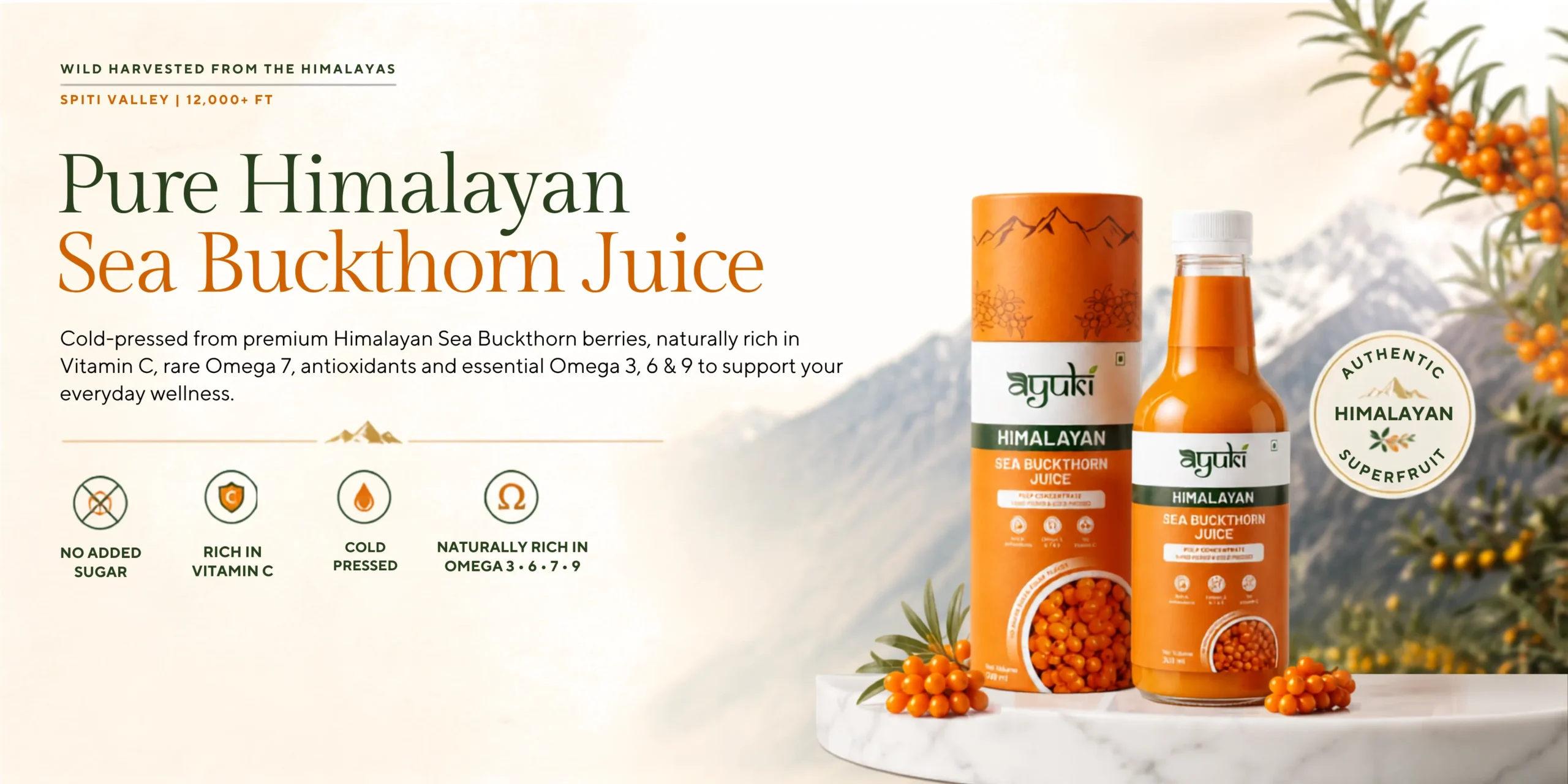
Let’s start with what’s on the label. Ayuki’s Himalayan Sea Buckthorn Juice Pulp contains 10x the Vitamin C of an orange, gram for gram. That’s the claim, and it’s the correct one — not 12x, not 15x, just 10x. If you’ve seen bigger numbers floating around Ayurvedic wellness content before, treat those as outdated; 10x is what’s actually on the bottle.
For context, an orange is the fruit most of us mentally reach for when we think “Vitamin C.” It’s a reasonable benchmark — accessible, familiar, genuinely rich in the vitamin. Sea Buckthorn simply starts from a much higher baseline.
But here’s the thing about Vitamin C claims in general: a high starting number doesn’t tell you much on its own. Vitamin C is famously fragile. It breaks down with heat, with time, with exposure to air — which is exactly why a lot of “high Vitamin C” claims on wellness products quietly become much lower Vitamin C realities by the time the product reaches your kitchen shelf.
So the real question isn’t “how much Vitamin C does Sea Buckthorn start with.” It’s “how much of that actually survives.”
The Real Reason This Vitamin C Survives Processing
This is where Sea Buckthorn does something genuinely unusual, and it comes down to one specific enzyme: ascorbate oxidase.
Ascorbate oxidase is the enzyme responsible for breaking Vitamin C down once a fruit is cut, crushed, or processed — it’s the biological reason a fresh-cut orange loses potency faster than you’d expect, and why most Vitamin C-rich juices need to be consumed almost immediately or specially stabilized to hold onto their nutritional value.
Sea Buckthorn largely lacks this enzyme. In plain terms: there’s very little in the berry itself actively working to destroy its own Vitamin C content after processing. That’s not a formulation trick or an additive — it’s simply how the fruit is built. It’s a big part of why Sea Buckthorn’s Vitamin C content holds up meaningfully better through processing than fruits that are naturally rich in the vitamin but don’t have this same protection.
This matters more than the raw “10x” figure does, honestly. A high number that degrades to almost nothing by the time it reaches you isn’t worth much. A number that survives is.
It’s Not Just Vitamin C — The Fuller Picture
Vitamin C gets the headline, but it’s not the only reason Sea Buckthorn has earned its reputation in Ayurvedic wellness circles.
All four Omegas, including the rare one. Most plant-based Omega sources give you one, maybe two of the Omega fatty acids. Sea Buckthorn is one of the few plant sources that contains all four — Omega 3, 6, 7, and 9. The standout is Omega-7 (palmitoleic acid), which is genuinely rare in plant form; most dietary sources of Omega-7 come from fish or animal fat, which makes Sea Buckthorn a notable exception for anyone building a plant-based routine.
190+ bioactive compounds. Beyond the vitamins and fatty acids, Sea Buckthorn carries a dense mix of over 190 bioactive compounds — the broader family of plant nutrients that includes antioxidants and carotenoids. This is part of why the berry shows up so often in skin- and immunity-focused Ayurvedic formulations specifically, rather than being treated as a general-purpose supplement.
No added sugar. Ayuki’s Sea Buckthorn juice pulp is 99.9% pure, with no added sugar — which matters if you’re trying to add a daily wellness habit without also adding to your sugar intake.
Where This Berry Actually Comes From
Ayuki’s Sea Buckthorn is GI-tagged, sourced from Spiti Valley at roughly 12,000 feet. The GI (Geographical Indication) tag isn’t a marketing flourish — it’s a formal designation tied to origin, similar in spirit to how Champagne or Darjeeling tea are protected by where they’re actually grown. It means this Sea Buckthorn is verifiably from where it claims to be from, not a generic import repackaged with a Himalayan label.
The berries are hand-picked and cold-pressed, which is a slower and more expensive process than mass extraction methods — but it’s also gentler on exactly the compounds we’ve spent this whole article talking about.
Sea Buckthorn also has a longer, more colorful history than most people expect from a wellness ingredient. As the story goes, it’s associated with the diets of Soviet-era cosmonauts and, further back, with feeding Genghis Khan’s war horses for stamina and recovery. We’ll say upfront: we haven’t independently verified either of those historical claims, and we’re presenting them here as the folklore they are, not as documented fact. What’s verifiable is the berry’s more recent, well-documented place in Ayurvedic and Himalayan wellness traditions — that part doesn’t need embellishing.
FAQ
Does Sea Buckthorn really have more Vitamin C than an orange?
Yes — Ayuki’s Sea Buckthorn Juice Pulp contains 10x the Vitamin C of an orange, gram for gram. It’s also more likely to retain that Vitamin C through processing, thanks to naturally low levels of the enzyme that normally breaks Vitamin C down.
What is Omega-7, and why does it matter?
Omega-7 (palmitoleic acid) is a fatty acid that’s uncommon in plant-based sources — most Omega-7 in typical diets comes from fish or animal fat. Sea Buckthorn is one of the few plants that contains meaningful Omega-7 alongside Omega 3, 6, and 9.
Is Sea Buckthorn juice good for skin?
Sea Buckthorn’s combination of Vitamin C, Omega fatty acids, and 190+ bioactive compounds is part of why it’s a popular ingredient in skin- and immunity-focused Ayurvedic wellness routines. As with any supplement, individual results vary, and it should be used as part of a broader wellness routine rather than a standalone fix.
How is Ayuki’s Sea Buckthorn juice made?
It’s hand-picked and cold-pressed from berries grown in Spiti Valley, at around 12,000 feet — a slower process than mass extraction, chosen to be gentler on the nutrients the berry is known for.
Is Ayuki’s Sea Buckthorn juice GI-tagged?
Yes. The GI (Geographical Indication) tag confirms the Sea Buckthorn is verifiably sourced from its stated Himalayan origin, not a generic import.
Conclusion
The “10x the Vitamin C of an orange” claim is real — but the more interesting part of the story is why that Vitamin C is actually still there by the time it reaches you, alongside a fuller nutritional picture that includes all four Omegas, 190+ bioactive compounds, and a genuinely traceable Himalayan origin.
If you’re curious whether Sea Buckthorn fits your own wellness routine, our doctors offer a free 15-minute Ayurvedic consultation — a good next step if you’d rather talk it through than guess. Or explore Ayuki’s Himalayan Sea Buckthorn Juice Pulp directly.